%20resized.jpg)

Members of the Antarctic Sea Ice Switch (ASIS) team joined New Zealand and international researchers at the Climate and Cryosphere (CliC) Open Science Conference in Wellington in February 2026. The conference brought together experts across disciplines to explore the changing cryosphere, its connections to the climate system, and its regional and global consequences. Contributions spanned modelling, observational science, social science and community engagement, reflecting the breadth of challenges and responses required.
ASIS team members showcased research highlights, convened multiple sessions, and led facilitated workshops. Sea ice was a central theme throughout the meeting, including a dedicated pre-conference workshop, five well-attended conference sessions, and a focused session of poster presentations.
A unifying thread across the conference was a strong sense of urgency. Participants highlighted the accelerating mass loss from the Antarctic and Greenland ice sheets, the abrupt decline in Antarctic sea ice, and widespread glacier retreat worldwide. The message was clear: these changes are no longer distant concerns but are already affecting hundreds of millions of people, as well as ecosystems, infrastructure, and economies globally.
Discussions consistently underscored the far-reaching impacts of a rapidly changing cryosphere. Ongoing losses in sea ice, ice sheets, ice shelves, and glaciers are driving sea-level rise, altering ocean systems, global heat and carbon budgets, and amplifying feedbacks within the global climate system—with consequences for food and water security as well as increasing the severity of storms, droughts, floods and fires.
The conference provided an important platform to bring together leading scientists, policymakers, and community leaders to share knowledge and advance strategies for mitigation and adaptation.
At the same time, there was a strong sense of momentum and hope. Advances in understanding across disciplines and nations are accelerating, alongside growing public support for decisive climate action. Upcoming international initiatives, including Antarctica InSync (2027-2030) and the 5th International Polar Year (IPY5, 2032–2033), offer critical opportunities for coordinated, interdisciplinary collaboration to support informed decision-making and address the challenges ahead.
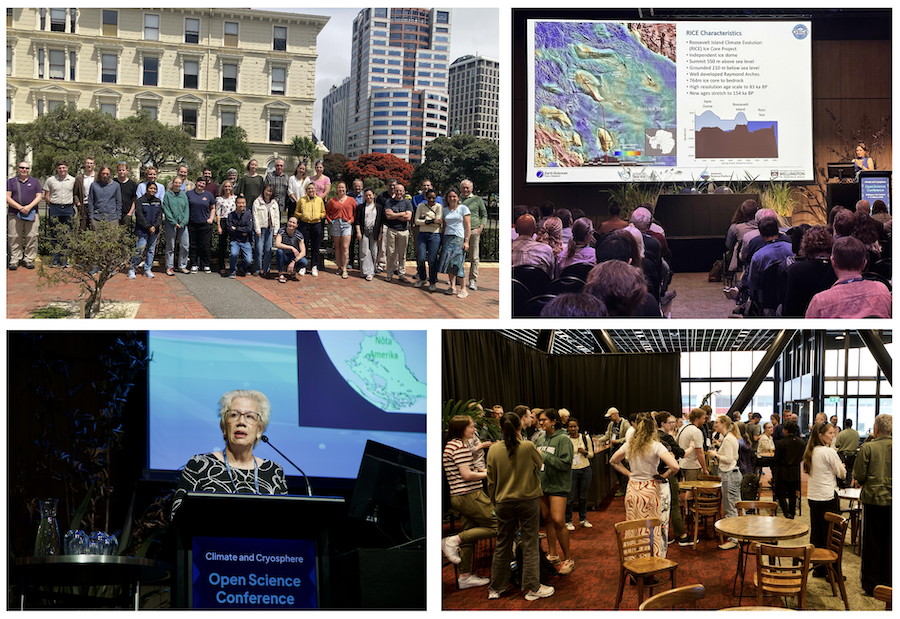
Eight presentations (oral and poster) were co-authored bymembers of our team. You can read the abstracts here.
- Sensitivity of climate and ocean circulation toWest Antarctic Ice Sheet extent in past interglacials
- The Roosevelt Island Climate Evolution (RICE)Ice Core: Insights into Antarctic deglaciation climate and ice dynamics
- Cultural Values in International DecisionMaking: Antarctica’s Liability Annex
- Towards coupling an improved sea ice model to ahigh-resolution regional atmosphere-ocean model of the Ross Sea region
- Representation of the Ross Sea Ice in CMIP6climate projections
- Using brittle physics to model Antarctic sea icevariability
- Exploring the Impact of Polar Cyclones onAntarctic Sea Ice with a Brittle Sea Ice Model
- Linking East Antarctic temperature and SouthernOcean productivity: A paleoclimate and modelling approach